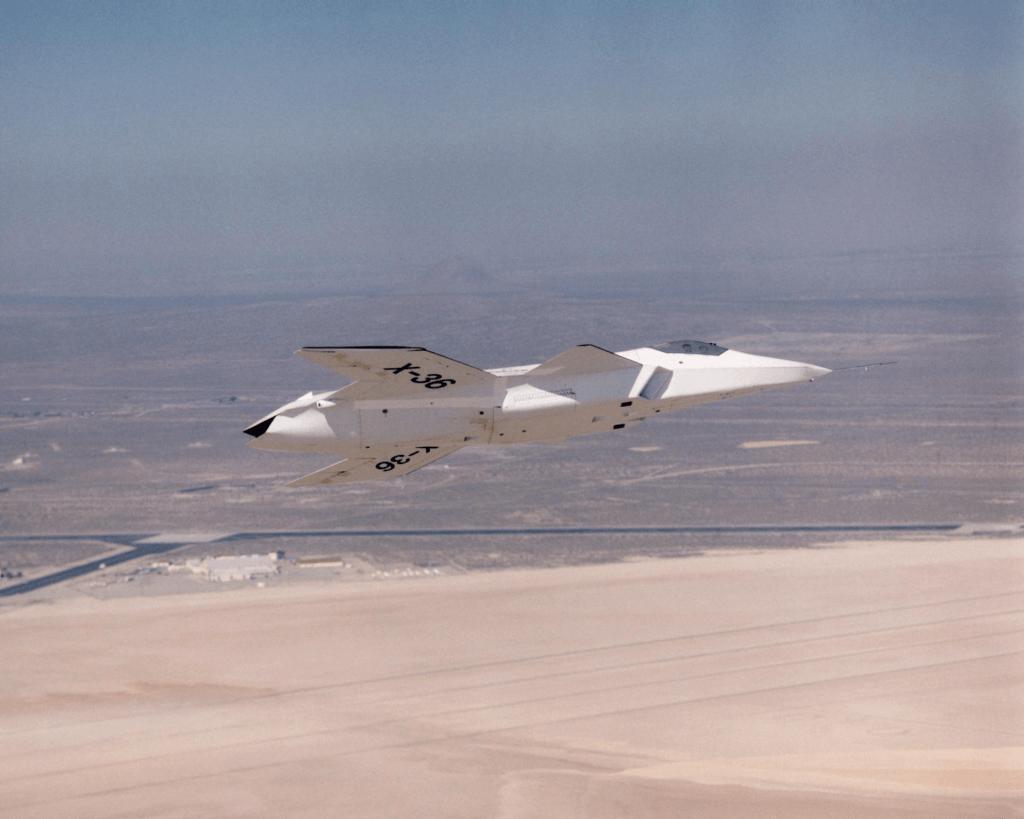
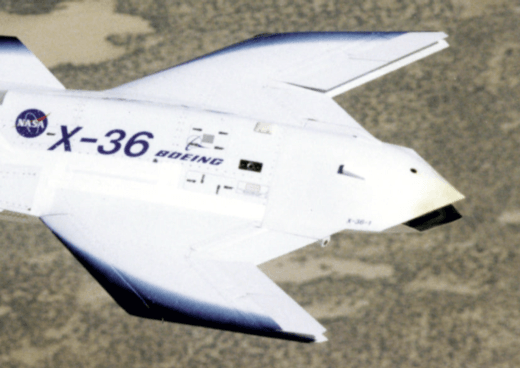
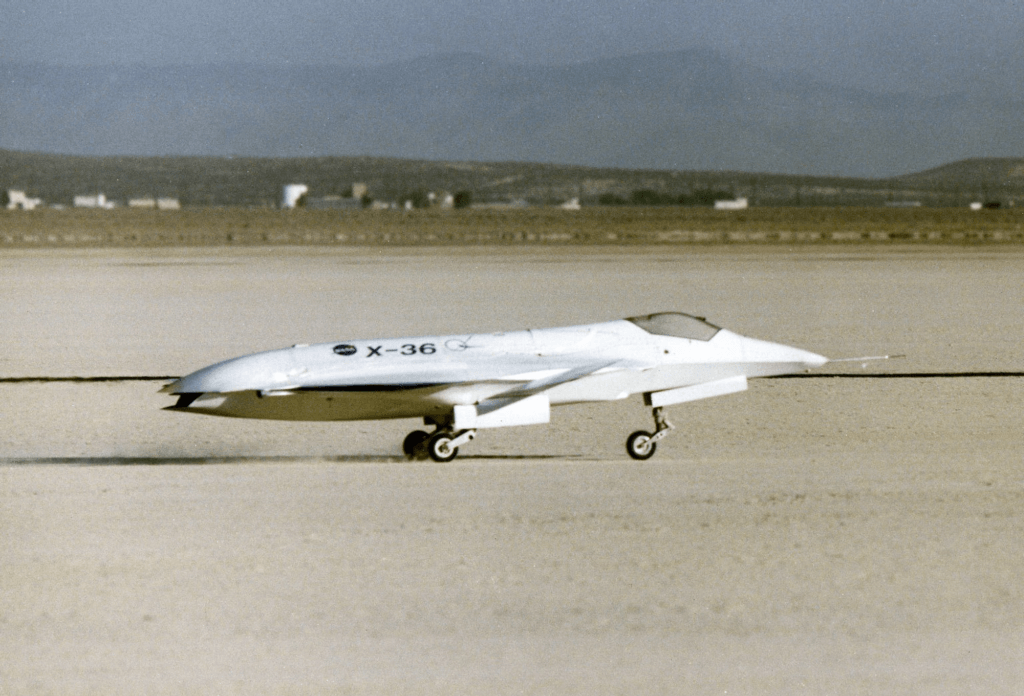
An enthusiast archive for the NASA / Boeing (McDonnell Douglas) X36 Tailless Fighter Agility Research Aircraft — a 28%-scale, remotely-piloted demonstrator that deleted the vertical and horizontal tails and still proved it could turn, point, and fly. Two were built. Thirty-one research flights, then two more for follow-on adaptive-control trials. Zero tails.

In the mid-1990s, NASA and the McDonnell Douglas (soon Boeing) Phantom Works set out to answer a deceptively simple question: could a fighter fly — and fight — with no tail at all?
A conventional tail does heavy lifting. The vertical fin keeps the nose pointed straight; the horizontal stabilizers control pitch. But tails are costly: they add weight and drag, and their flat upright surfaces are radar mirrors that light an aircraft up on an enemy scope. Strip them away and — in theory — you gain range, agility, and stealth, if you can keep the thing controllable.
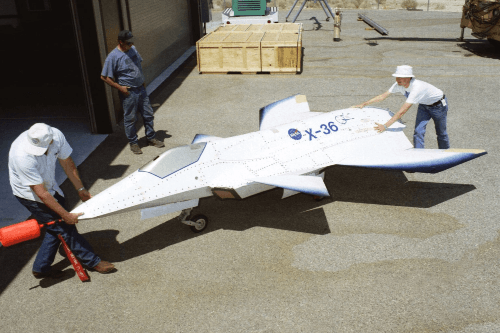
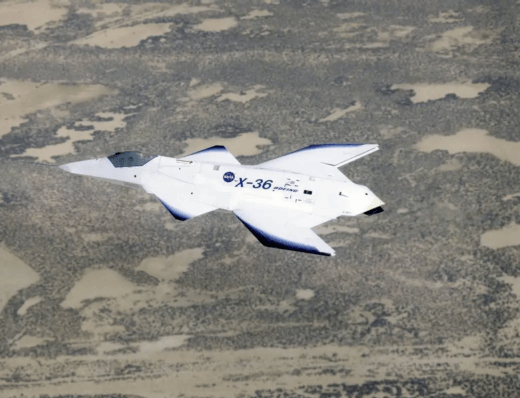
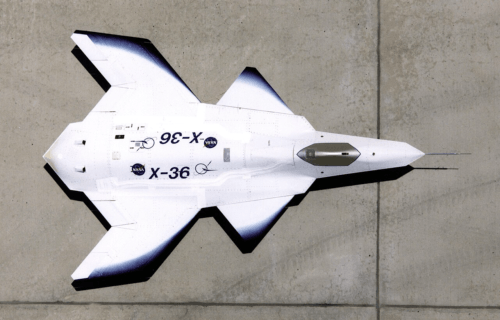
The X36 was the flying proof: a 28-percent-scale model of a theoretical advanced fighter with no vertical or horizontal tail. In their place it used a forward canard, split ailerons on the wing trailing edge, and a single thrust-vectoring nozzle.
Such a tailless shape is naturally unstable in pitch and yaw, so the aircraft leaned on a fast digital fly-by-wire system making tiny corrections many times a second — a job no human reflexes could do unaided.
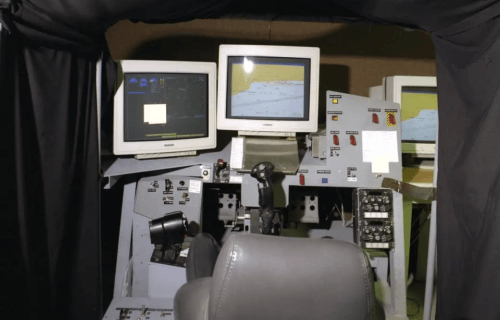
There was no cockpit aboard. The two X36s were remotely piloted from a ground station, where the pilot sat in a "virtual cockpit" with a head-up display, looking out through a nose-mounted video camera. From the seat it felt like flying a full-size jet — the picture just happened to be beamed down from a 19-foot machine in the desert sky.
On a normal jet, you yaw left or right by deflecting the rudder on the vertical fin. The X36 had no fin and no rudder. So how did it turn its nose?
Split ailerons. Each trailing-edge control surface could split open like a clamshell — top half up, bottom half down — creating drag on one wing without rolling the aircraft. Asymmetric drag swings the nose: instant yaw control, no fin required.
Thrust vectoring. The engine's exhaust nozzle deflected the jet stream to point the nose — especially powerful at low speed and high angle of attack, where ordinary control surfaces lose their bite.
Canards. The small foreplanes ahead of the wing supplied the pitch authority a horizontal stabilizer normally provides and helped keep the aircraft agile at high angles of attack.

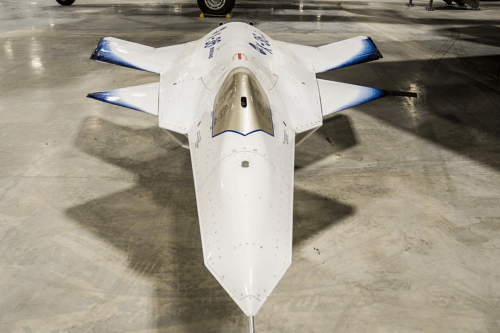
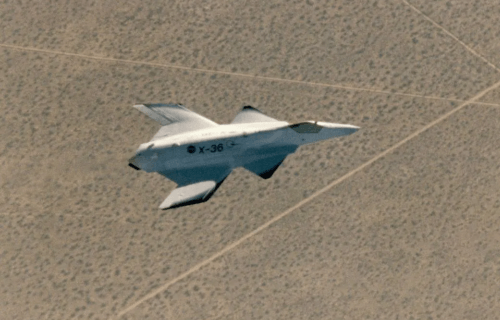
Visual Reference: Explore real photographs of the X36's unmistakable silhouette — a blended wing-body featuring a chined nose, forward canards, and a clean trailing edge where the tail would normally be.


| Designation | X36 (X36A) · Tailless Fighter Agility Research Aircraft |
|---|---|
| Builder | McDonnell Douglas / Boeing "Phantom Works", St. Louis MO |
| Type | Remotely-piloted subscale technology demonstrator |
| Number built | 2 |
| Scale | 28% of a theoretical advanced fighter |
| Length | 19 ft (≈ 5.55 m) |
| Wingspan | ≈ 10 ft (≈ 3.1 m) |
| Height | 3 ft (≈ 0.9 m) |
| Weight (fueled) | ≈ 1,250–1,300 lb (≈ 560–590 kg) |
| Landing gear | Retractable tricycle |
| Powerplant | 1 × Williams International F112 turbofan |
| Thrust | ≈ 700 lbf (≈ 3.1 kN) |
| Top tested speed | 206 kn (≈ 234 mph) |
|---|---|
| Max altitude | ≈ 20,200 ft |
| Max angle of attack | ≈ 40° |
| Pitch control | Forward canards + fly-by-wire |
| Yaw control | Split ailerons + thrust vectoring |
| Tail surfaces | None — no vertical fin, no horizontal stabilizer |
| Stability | Unstable in pitch & yaw; stabilized by digital FBW |
| Piloting | Ground "virtual cockpit"; nose camera + HUD |
| First flight | 17 May 1997, NASA Dryden, Edwards AFB |
| Original program | 31 flights, ended 12 Nov 1997 (15 h 38 m) |
| With RESTORE | 33 flights total (two more, Dec 1998) |
| Status | Retired — goals met or exceeded |
Sources vary slightly (e.g. 1,250 vs 1,300 lb fueled, exact span); figures shown as published ranges where they differ.
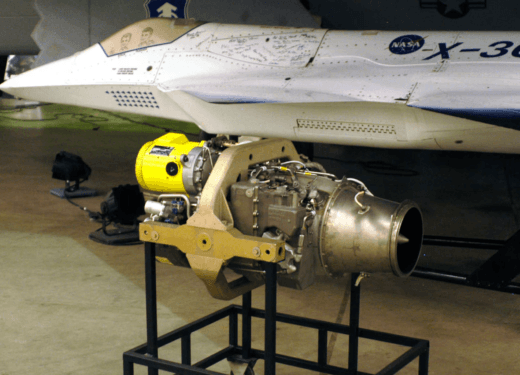
The X36's single jet was a Williams International F112 turbofan — and its résumé is unusual for a research aircraft: it was born to power America's stealthy cruise missiles.
The F112 belongs to a family of tiny, lightweight turbofans Williams pioneered in the 1970s. Its direct ancestor, the F107 (company designation WR19), powers the AGM-86 Air-Launched Cruise Missile and the BGM-109 Tomahawk. The uprated F112-WR-100 was developed to push the stealthy AGM-129 Advanced Cruise Missile farther and quieter, and the same engine family also turned up in experimental craft like the X36 and the later Boeing X-50 Dragonfly.
For a subscale demonstrator on a tight budget, a missile engine was close to ideal: it was small, light, proven, and available off the shelf. Missiles have almost no internal volume to spare, so these engines were engineered from the start for minimum size and weight — exactly what you want when your whole aircraft is only 19 feet long.
On the X36 the F112 produced roughly 700 pounds of thrust (the family spans about a 600–840 lbf class depending on variant). Crucially for this aircraft, its exhaust fed a special thrust-vectoring nozzle that could deflect the jet to help steer the nose — one of the tricks that let the X36 keep flying without a tail.

| Maker | Williams International |
|---|---|
| Type | Small two-shaft (twin-spool) turbofan |
| Developed from | Williams F107 (WR19) |
| Designation lineage | F107-WR-14A6 → F107-WR-103 → F112-WR-100 |
| Length | ≈ 29.5 in (750 mm) |
| Diameter | ≈ 12 in (300 mm) |
| Weight | ≈ 145 lb (66 kg) |
| Bypass ratio | ≈ 1 : 1 |
| Thrust class | ≈ 600–840 lbf (≈ 700 lbf on the X36) |
| Other users | AGM-129 ACM · AGM-86 family · Boeing X-50 |

Once the original 31-flight program had proven the tailless airframe, the X36 got a second life as the test-bed for something genuinely futuristic: flight-control software that could heal itself.
The U.S. Air Force Research Laboratory (AFRL, Wright-Patterson AFB) contracted Boeing to fly RESTORE — Reconfigurable Control for Tailless Fighter Aircraft. Its goal was to show that an online neural network could keep an unstable, tailless aircraft flying safely even after a control surface was damaged or jammed.
Under the hood, RESTORE used dynamic inversion in an explicit model-following framework: the system computes the control inputs needed to make the aircraft behave like an ideal reference model, while a neural network learns and cancels the leftover error in real time — error that could come from modeling uncertainty, damage, or a failure. It ran alongside the original, proven control laws as a safety net.
The tests were deliberately brutal. Engineers locked control surfaces at fixed positions to simulate jammed actuators — and critically, the control law was never told a failure had occurred, and there was no fault-detection logic to tip it off. The neural net simply sensed the aircraft misbehaving and re-tuned itself. Every time, it compensated and kept the X36 flying.
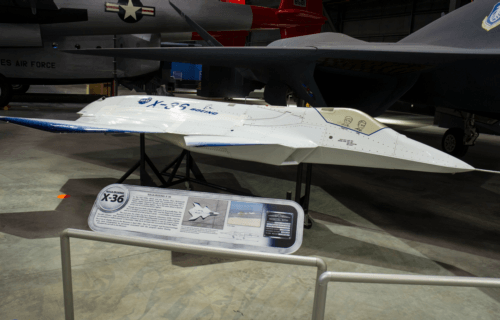
These images highlight the unique aerodynamic profile of the X-36, capturing the true essence of its appeal.


The X36 never carried a weapon, never flew a combat sortie, and was barely larger than a sports car. Yet it quietly answered a question that has shaped stealth aircraft ever since.
By proving a tailless, naturally-unstable fighter shape could be flown agilely and safely using split ailerons, canards, thrust vectoring, and fast digital controls, the program de-risked the tailless concept for the designs that followed. Its control philosophies fed into later Boeing programs — most notably the X-45 unmanned combat air vehicle demonstrators — and into the broader family of low-observable, tail-light aircraft.
RESTORE went further still, demonstrating adaptive, self-reconfiguring flight control — a forerunner of the resilient autonomy modern uncrewed aircraft depend on.
Both airframes are retired today, and you can stand next to one in person: an X36 is preserved at the National Museum of the United States Air Force in Dayton, Ohio — a small, fin-less reminder that big leaps sometimes come in small packages.